
SMALL CELLS · PUBLIC LIGHTING · 5G/6G
Turning public streetlight poles
into shared 5G infrastructure
Kotower, a Kawantech subsidiary, coordinates municipalities, energy syndicates, towercos and mobile operators to deploy discreet Small Cells on existing public assets - streetlight poles - with less civil engineering, less visual impact, and new economic value for local territories.
THE ORIGIN: A LEGAL OBLIGATION IN THE SERVICE OF CITIZENS
The GIA opens access to existing infrastructure,
including streetlight poles
Applicable in France since Nov. 2025 · French CPCE adaptation 2026
EU Regulation 2024/1309 aims to accelerate the deployment of gigabit networks by reducing civil works costs and facilitating access to existing physical infrastructure. Its transposition into the French CPCE extends the notion of host infrastructure to urban furniture owned or controlled by public entities, including streetlight poles.
As a result, operators and their infrastructure partners may request access to these assets under fair, reasonable and non-discriminatory conditions. For local authorities, this creates a framework for organising the use of public space, retaining sovereignty over the pole, and formalising the value created.
As a transformation enabler, Kotower supports cities, local authorities and energy syndicates through every step: technical inventory, demand analysis, co-management, compliance and integration on streetlight poles.
What changes
Streetlight poles and urban furniture become mobilisable assets for very high-speed networks.
What remains essential
Urban planning, safety, radio compliance, occupancy agreements and public lighting responsibility must all be properly framed.
What Kotower brings
A method to qualify, contractualise, deploy and operate — without turning the mobile operator into a public lighting manager.
Less civil engineering
Reusing an existing pole for two services (light and data) is the very essence of urban sobriety.
Health
Small cell architecture allows an overall reduction in average transmission power and optimal compliance with current exposure standards. Small cells ensure lower radiation levels for the population than current radio solutions.
More capacity
80% of internet usage now takes place on smartphones (Arcep 2026). With HD video, video calls, tethering and now AI, demand continues to grow.
Rental income
Transforming public assets into rental opportunities. By managing access to its poles, the city transforms a management and cost burden into a virtuous economic model - capturing the rental flows from telecom infrastructure.
Local employment
The Kotower approach allows streetlight upgrades and first-level radio station maintenance to be carried out by existing teams already responsible for public lighting. The sector builds skills (and revenue...).
White zone coverage
The Kotower solution adapts to all contexts: rural, peri-urban, tourist or town centre. 5G becomes accessible everywhere it was previously absent - without heavy new infrastructure.
WHY NOW
Mobile densification can no longer rely solely on large towers
5G - and tomorrow 6G - requires antennas closer to users. Classic locations (rooftops, pylons, macro sites) are becoming scarce, expensive and sometimes poorly accepted by residents. Small cells shift value towards the precise location, power supply, fibre and coordinated operation.
1
Higher frequencies
More throughput, but shorter range: radio points must be brought closer to usage areas.
2
Visual acceptability
Compact stations integrate into existing furniture rather than adding new pylons.
3
Economy & Sobriety
Sharing a powered and fibred pole avoids the multiplication of new urban furniture.
THE TECHNICAL ANSWER
Miniaturisation through the 5G small cell
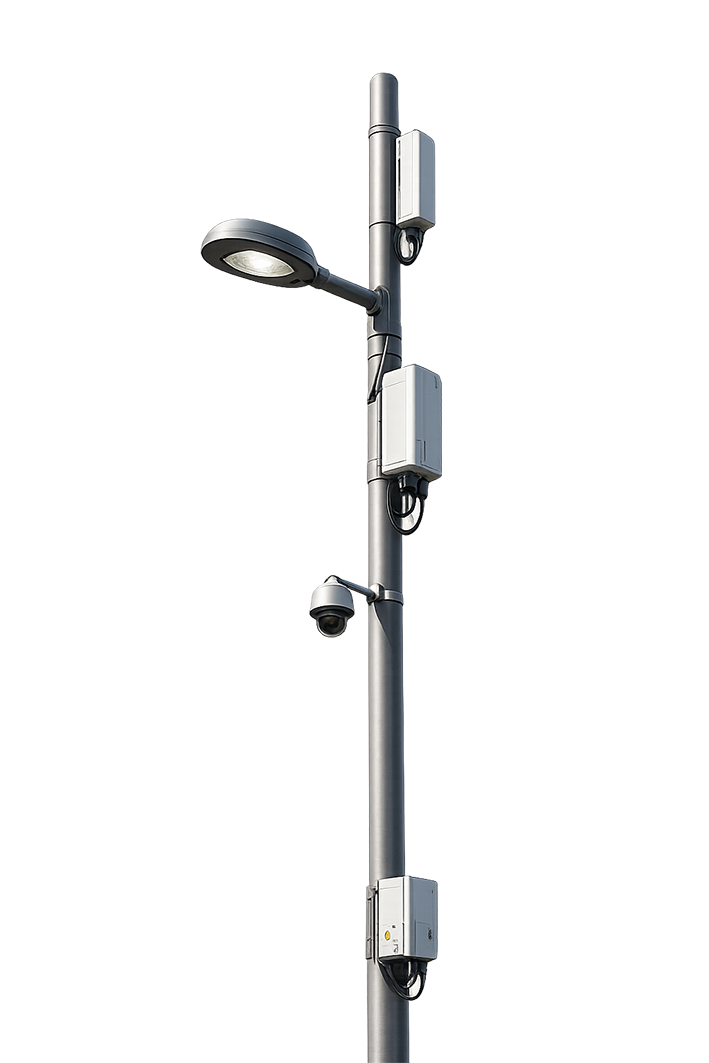
To meet new legal obligations without turning city centres into forests of pylons, technology offers an elegant solution: the small cell. These miniature antennas - the size of a shoebox - are designed to sit atop streetlight poles. With them, 5G network densification, essential for new digital uses, is achieved with complete discretion. By reusing existing urban furniture, the municipality complies with the law while preserving its landscape and street architecture.
ADVANTAGE FOR MUNICIPALITIES
Lease the high point, without losing control of the pole
The local authority remains the owner of its public lighting, chooses acceptable locations, manages the occupation of public space, and can collect fees for the use of the pole. The TowerCo mutualises access between operators, while the telecom equipment remains separate from the public lighting section.
The model can also leverage ducts, fibres or civil engineering services already mastered locally, with works carried out by the usual public lighting teams and installers.
PICOCELL / HOTSPOT
≈ €250/year
Dense area, coverage gap, light active equipment.
SMALL CELL
≈ €600/year
Neighbourhood or village coverage, as a complement to a macro cell.
SMALL-MACRO
≈ €1 000–1 200/year
Multi-operator support, broader and shared coverage.
KOTOWER BY KAWANTECH
The pioneer bridging public lighting, civil engineering and mobile telecom
Kotower leads the engineering of this transformation: pole qualification, radio consistency, power supply, fibre, usage agreements, cross-documentation and works supervision. The subsidiary builds on Kawantech's experience in connected public lighting and on experiments conducted with the telecom ecosystem.
The objective: making industrialisable a deployment that is too cross-disciplinary to be handled by a mobile operator, a local authority or a civil engineering company in isolation.
01
Qualify
Cross-reference radio, public lighting, fibre, energy, urban planning and local acceptability data.
02
Coordinate
Organise the relationship between municipality · TowerCo · operators · BTP/energy installers.
03
Deploy
Standardise installation procedures: civil engineering, power supply, fibre and commissioning.
04
Operate
Monitor pole condition, access, documentation and interventions over the long maintenance cycle.
FROM STUDY TO IMPLEMENTATION
From a network constraint to a territorial revenue stream
Kotower supports the first pilot territories to identify high-potential poles, secure the contractual framework, and build discreet, sober and operable Small Cell sites.